Yi Bai Shuǐmò 一白水墨
Born in the Yangzhou region, land of water and fishing nets; studio in Nanjing. Twenty-five years of ink wash painting, to keep only three elements, a line, a black, a white, and a single discipline: repetition.
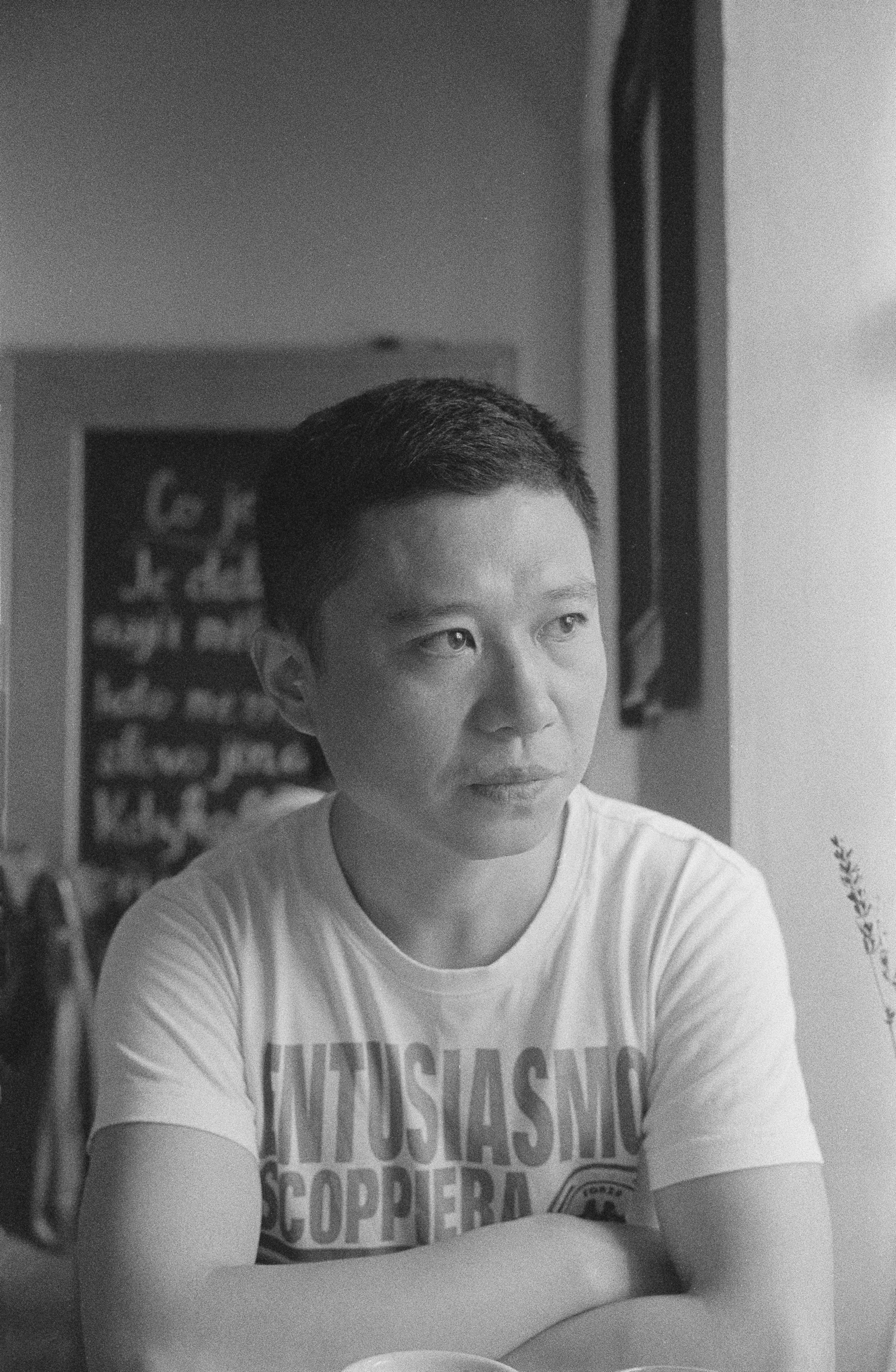
« From the very first day I approached ink wash painting, I swore to become a painter unlike others. For art is freedom, and art exists precisely because of its creative nature. »
Yi Bai began by copying traditional landscape painting, then left it behind to paint outdoors; it took him years to unlearn what he knew. The materials have stayed those of tradition, brush, pine-soot ink, rice paper, the technique has not: ink wash is now no more than a material support for a way of thinking, that of Chan, which commands breaking the rules and trusting the intuition of the moment.
Two discoveries hold the work together. The 'black,' born of a shortage of paper during the lockdown. The line, inherited from the fishing nets, a series that shed the water, the reflections, the boat, then the ink itself. Since 2025, certain works are made of nothing but crossed straight lines, by the thousand, up to 124 × 124 cm.
The vocabulary
What was abandoned
Wash splashed ink hemp-fiber texture strokes axe-cut texture strokes color scattered perspective the scholar’s boat the ritual white reserve in the lower right ancient models theories the fixed order of steps
« I have eliminated every classical method of texture stroke, hatching, dotting and wash, to keep only the line, nothing but straight lines. »
Subtraction does not impoverish: it is the condition for a language of one’s own. « Dare to cast off the ideas and techniques of the ancients and of contemporaries alike, to finally find oneself. »
Black
A thousand characters for one stain
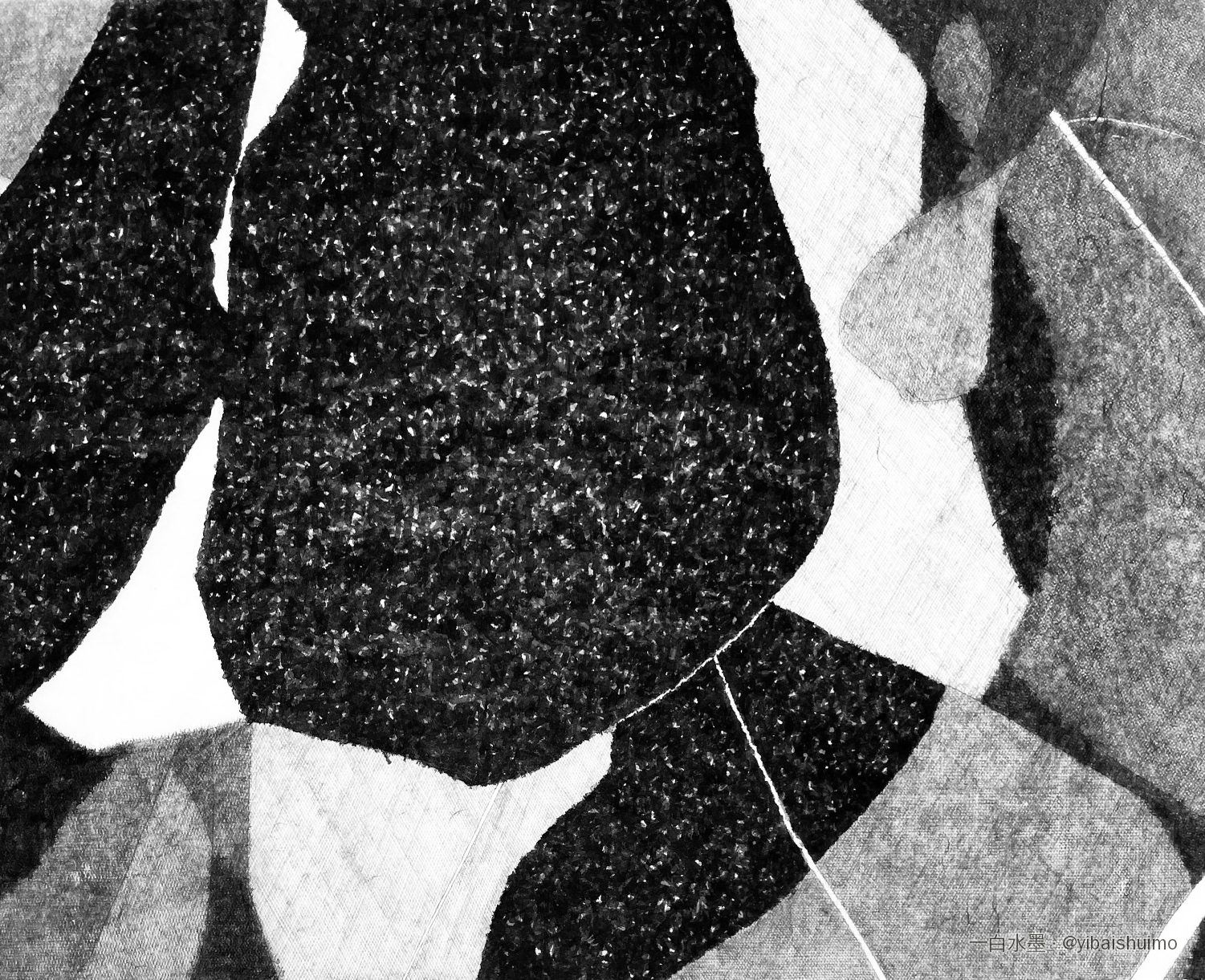
During the lockdown, short of practice paper, Yi Bai copies out Huai Su’s Thousand Character Classic in cursive script onto rice paper, more precious. To save the sheet: pale ink, front and back, upside down, layer upon layer. The white sheet ends up black.
The process becomes a technique. A 'black' of a few square centimeters can demand a complete copy of the text; to the touch, the surface is granular, raised in relief, and no character is legible.
« Though I have written a multitude of characters, no trace of the writing is visible. This raises the practice to a philosophical level: art reaches the height of uselessness. »
Yi Bai
Profile
Biography
- Artist name
- Yi Bai 一白, Qian Chuanbing
- Born
- Yangzhou, Jiangsu Province, China
- Studio
- Nanjing, Jiangsu Province, China
- Education
- Master of Arts, Nanjing Normal University
- Member
- Chinese Artists Association, China
Jiangsu Artists Association, China
Association Yang Zi, France - Public collection
- Jiangsu Art Gallery, Nanjing, Mountain and Water, acquired in 2006
- Award
- Mountain and Water, awarded at the 3rd Jiangsu Chinese Painting Exhibition, December 2006
- Publications
- ‘The Beauty of Beauties under the Tang Dynasty,’ essay, Southwest Culture no. 12, 2002
Autumn Paddies, reproduction, Art Observation no. 11, 2008
Materials
- Support
- Rice paper (xuan). For reproductions, 'chanyi' paper, as thin as a cicada’s wing.
- Ink
- Pine-soot ink, diluted. Almost never used at full strength.
- Tool
- Chinese brush, including a fine-line brush for delicate strokes. Pencil for on-site sketches.
- Duration
- Up to several weeks of daily work.
Yi Bai
Timeline
- around 2000
First contact with ink wash painting, after years spent copying traditional landscape painting.
- March 2010
Kraków. In front of the church where John Paul II rests, the first painting from life where heart and hand finally agree. « From this day, my brush came alive. »
- around 2010
First Fishing Net work: leaning bamboo, a boat, reflections. The series that would become his language.
- 2016 to 2018
Extended stays in Hunan, his wife’s home province. Dozens of works painted from the motif each week.
- 2020
Proportion, 140 × 160 cm, and the Nothing series. Splashed ink still coexists with the line.
- 2020 to 2022
Lockdown. Short of practice paper, he copies Huai Su’s Thousand Character Classic onto rice paper, over and over, until a textured black emerges. The ‘black’ enters the work. He begins painting his wife’s body.
- 2024 to 2025
The black landscapes. From the motif, recording only what is dark enough; everything else disappears.
- May 2025
Abandonment of every ink stain. Only the straight line remains: parallel, crossed, repeated.
- April 2026
Invited by the municipality of Saint-Mathurin-sur-Loire, he paints the Loire from La Ménitré for a month: solo exhibition « Loire Inks », April to June. Then the Atlantic at Batz-sur-Mer, where he exhibits until mid-September.
- 2026
Waiting, 124 × 124 cm: the largest format made purely in line.
Yi Bai
Exhibitions
-
2026
- Solo showLoire Inks, Saint-Mathurin-sur-Loire, France. April to June, on invitation from the municipality, following a painting-from-life residency at La Ménitré.
- By invitationBatz-sur-Mer, France, June to mid-September.
-
2025
- Group showNew Cluster Exhibition: Mobility, Slowness, Accumulation, Toku Gallery, Nanjing. February.
-
2024
- By invitationSong and Dance of the Wind, Bamboo Art, Nanjing. January.
- By invitationShui Mo Wei Du, Tongxi Art, Nanjing. August.
-
2022
- Art fairART021 Shanghai, Shanghai. November.
-
2021
- Art fairArt Amoy International Art Fair, Xiamen. June.
-
2020
- Art fairAArt Shanghai, virtual edition, Shanghai. November.
-
2019
- Solo showLe Croisic à l’encre de Chine, Galerie Chapleau, Le Croisic, France. September.
- Art fairAArt Shanghai, Shanghai. November.
- By invitationLa Rochelle Visual Arts Salon, France, works reproduced in the catalogue.
-
2018
- Group showVoyage entre l’eau et les nuages, ‘First Encounter’ artistic gathering, Moqingshe season 1, a Nanjing bookshop. January.
- SelectedRepetition, selected for the National Wannian Pujiang Chinese Painting Exhibition (gongbi section), Chinese Artists Association, Xianhua Wenjingyuan Center, Pujiang. September.
-
2017
- Group showChun Shan Ru Xiao, landscape painting, Jiangsu Provincial Art Museum, Nanjing.
- By invitationYun Shang Qing Nian, Nanjing Municipal Art Museum.
- Group showNational Traditional Chinese Painting Exhibition, Shanghai.
- Group showHan Mo Qingzhou, National Traditional Chinese Painting Exhibition, Qingzhou.
- Group showJinling New Rhythm, Jinling Art Museum, Nanjing.
-
2016
- Group showExercise One’s Inventive Mind, Tongxi Art Gallery, Nanjing.
- Group showNational Traditional Chinese Painting Exhibition, Huanghe International Convention and Exhibition Center, Dongying.
- Group showWei Lai Xing Tai, Jinling Art Museum, Nanjing.
- Group showL’Âme de l’encre et l’assonance des couleurs, Baguai Memorial Hall, Yangzhou.
- Solo showYi Bai: la Charente-Maritime à l’encre de Chine, Maison de la Charente-Maritime, La Rochelle, France.
-
2015
- Solo showQian Chuanbing, Fan Space Gallery, Beijing.
- Solo showLe Shui, Zhuzi Gallery, Nanjing.
- Solo showQiu Jian Yu Zhou, Liuchen Gallery, Nanjing.
- Group showRencontre poétique, Zhuzi Gallery, Nanjing.
- Group showRegard d’un pinceau chinois sur La Rochelle, University Library of La Rochelle, France.
- Group showNoir et blanc, ARTEC collective, Town Hall of the 5th arrondissement, Paris.
-
2014
- Solo showÀ ce moment, Fan Space Gallery, Beijing.
- Solo showRésonance d’été, Batz-sur-Mer, France. August 5 to 8.
- By invitationGrand Art, ink painting, Zheng Guan Gallery, Beijing.
- By invitationHaute qualité, ink painting of the young generation, Art+ Gallery, Nanjing.
- Group showObjets, works by young painters, Fan De Hall, Nanjing.
- Group showTop 50 of the Young Generation in Fine Arts, China Academy of Art Gallery, Hangzhou.
-
2013
- Group showErrances d’eau et de nuages, Fanspace Gallery, 798, Beijing. May-June.
- By invitationThe Great Painters of the Ming Dynasty, April.
-
2012
- Group showJie Mo Gallery, on the occasion of the 1st Young Artists Festival. January.
- Group showArt Puzzle Salon. July.
- By invitationThe Great Landscape Painters of Jiangsu Province. December.
-
2011
- Group show1st Good Art Festival. September.
- Group show1st New Energies of Chinese Painting Salon, Nanjing. December.
-
2010
- Solo showCafé Jéricho, Prague, Czech Republic. March.
- LectureChinese Painting and Calligraphy, followed by an exhibition, Rybanaruby Club, Prague. April.
-
2009
- Group showImpression de Xiangxi, 1st Xu Beihong Traditional Painting Exhibition. March.
- Solo showNational Museum of Prague, Czech Republic, March 13 and 14, with a lecture series on painting and calligraphy.
- LectureConfucius Institute of Olomouc, on invitation from the Chinese Embassy. March 25.
- Group showTout au long du chemin, Rong Bao House, Nanjing, with Sun Wei, Jiang Jian and Sun Yimei. September 23.
-
2008
- Group showRizières en automne, Li Jiancheng Art House.
-
2006
- Group show / Award / CollectionMontagne et Eau, 3rd Jiangsu Chinese Painting Exhibition, awarded, then acquired by the Jiangsu Art Gallery. December.
Going further
The painter keeps a chronicle of his own practice.
The genesis of a work, the birth of a black, reflections on Chan, a month spent painting the Loire.
Read the essays