Essays · Nets
The Evolving Path of the Fishing-Net Paintings
渔网创作的变化轨迹
The changes in my series of fishing-net works can be seen on two levels: the technique of making them, and the shift in the ideas behind them.
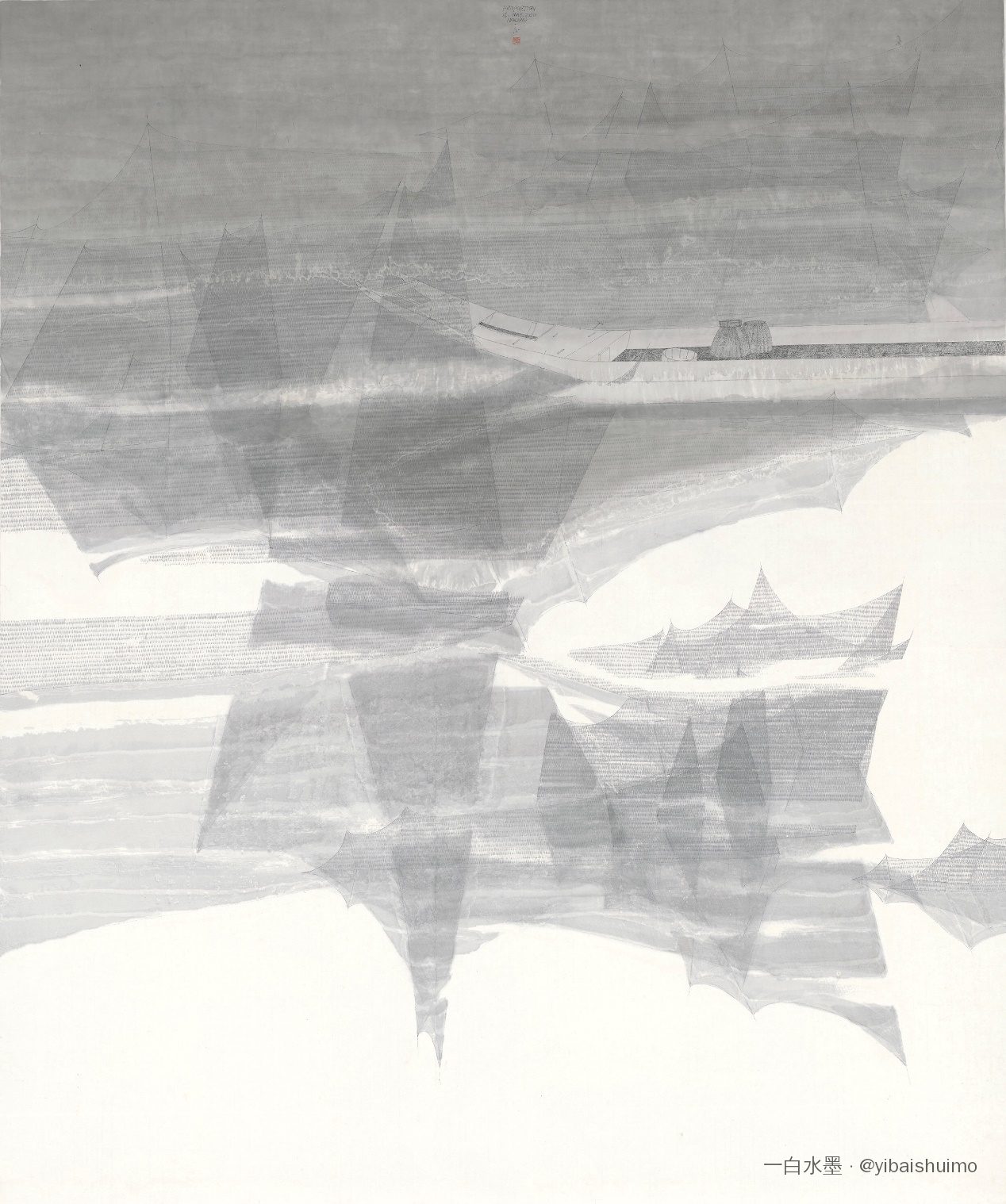
The early fishing-net paintings contained bamboo poles, fine nets, a boat, the surface of the water, a clouded sky, and the reflections of all these things. The technical process ran as follows. Facing a sheet of xuan paper, I would begin by flinging the ink, staining with the brush, dotting and rubbing, so as to build up the reflection of the sky's cloud-breath on the water; the ink had to be living, abundant, saturated, full of a sense of space. Then I drew the lines, raising the bamboo poles and establishing the connections between them: at the point where the poles enter the water I joined the related poles with straight lines, and at their tips with the natural gravity-curves, repeating the procedure. Then I found the place for the boat and drew its shape with straight lines and curves. Next I outlined with the brush the reflections of the poles, of the linked planes and of the boat, and laid a flat pale-ink wash over every linked plane and over the reflection of the boat, working from top to bottom until it was done. Finally, with an even paler ink, I filled in the linked planes above the waterline, simply ranging straight lines side by side; when one plane was filled I changed direction to cross it, and filled it again with ranged straight lines. Dense thickets of parallel and crossing lines, layer upon layer of pale ink, a water surface charged with cloud: the lines and the planes composed themselves naturally, and collided to produce effects no one could have foreseen.
Later the technique changed markedly. Facing a blank sheet, I no longer flung ink to build the atmosphere of the water. I drew the upright bamboo poles and the boat directly in straight lines, and rendered the links between the poles with straight lines and arcs. For the reflections I gave up every flat patch of pale ink. That is to say, neither the flat washes nor the flung ink of the earlier work were used at all; everything was done with straight lines or arcs alone. A painting was made almost entirely of straight lines crossed and repeatedly ranged. The thinking behind the fishing-net works changed visibly in this period: by removing the ink masses from ink painting, I kept only the purest line, and so opened a distance between my work and traditional ink painting.
Later still the technique did not change, but I removed the boat from the elements altogether. I had come to feel that the boat in the picture blocked the possibilities of my work. First, the boat has no bearing at all on my life now; at most it lives on in the memories of childhood. Second, the boat is a powerful cultural sign, carrying within it both the sense of a means of passage and a religious colouring. It is an essential accent in traditional landscape painting, in the landscapes of Jiangnan above all, where a boat is held to be indispensable. Although I reshaped it many times, making its form very different from the traditional boat, a boat remains a boat: the moment it appears in the picture, the work falls back at once into the language of ancient landscape.
From the very beginning of the fishing-net works I had the clear intention of breaking with traditional ink painting. Away with the classical techniques: the hemp-fibre stroke, the axe-cut stroke and all such handling of brush and ink; away with the language of traditional landscape, with
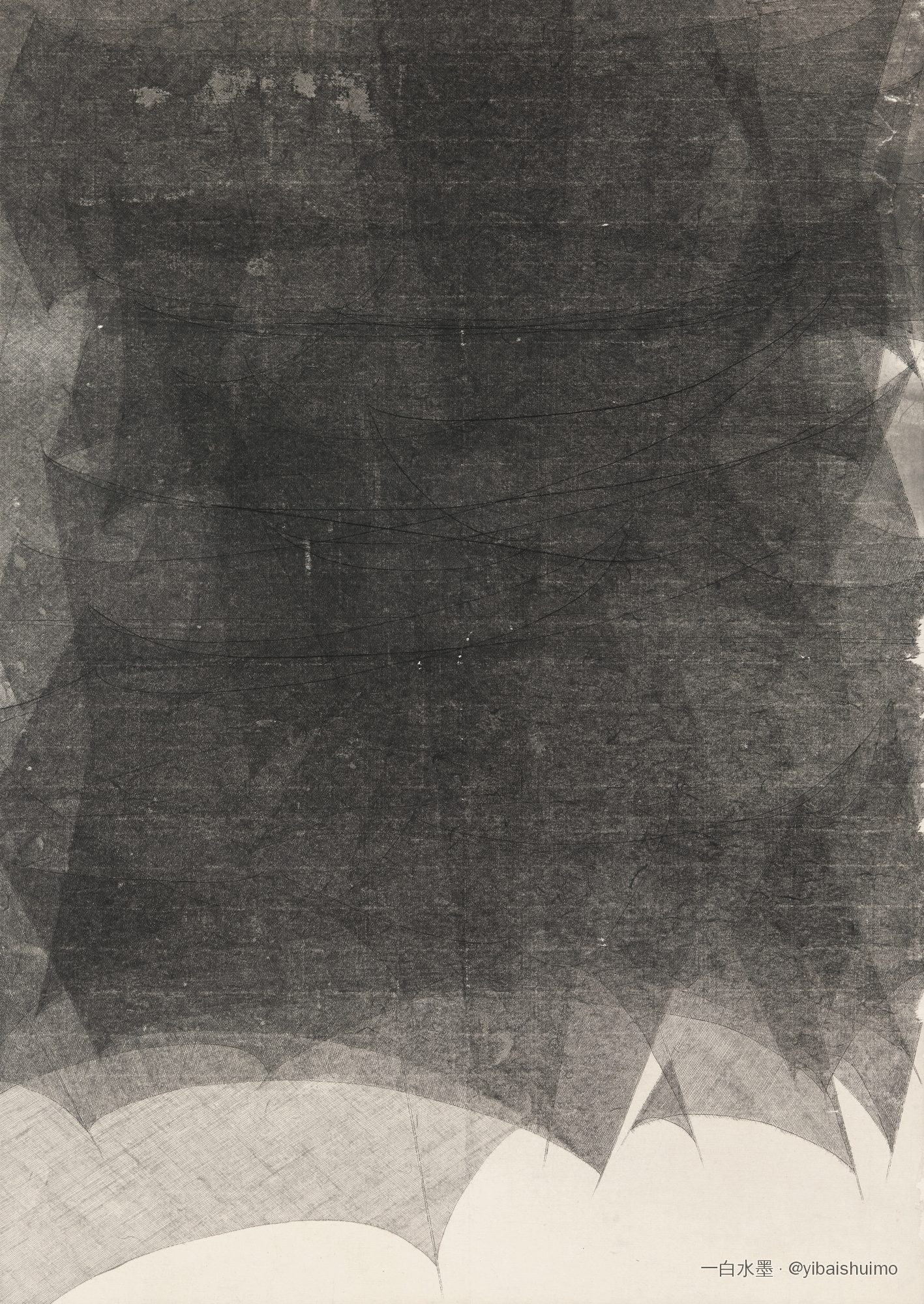
its scattered perspective in which every step gives a new view, its ideal of a place one may wander in and dwell in, its distinctive angles of deep distance, high distance and level distance, its longing for the spiritual homeland of the ancient literati. Traditional landscape is supremely classical, with a profound inner world, but it belongs to history: it has nothing to do with me, and still less with my work. In daily life I can admire it and look up to it; the moment I begin to paint, I abandon it without hesitation.
Here I think of a line from Yuan Mei, the Qing dynasty man of letters:
«At rest, one cannot be without the ancients for a single moment; brush in hand, one must not have the ancients within for a single moment. To keep the ancients in daily life is to deepen one's learning; to be free of them when painting is to let one's spirit come forth.»
By this point the fishing-net paintings held nothing but thousands upon thousands of lines: countless straight lines, crossing, evenly ranged, laid over one another again and again, with an effect all their own. Which echoes another saying of the ancients: «The Song painters made dense work, a thousand strokes, ten thousand strokes, and not one stroke that was not simple.»
In short, the fishing-net works began with both brush and ink, went on to brush without ink, and lately to brush without ink and without a boat. What will they become after that? I do not know. They can only unfold of themselves, by the principle of learning through doing.