Essays · Loire
April Reflections
四月随想
This April I was in France. At the invitation of the town council of Saint-Mathurin-sur-Loire I came to paint the Loire from life, and on the third I opened a solo exhibition. I was staying at La Ménitré on the bank of the Loire, where every day brings the weather of all four seasons: in the morning a cold wind whistling, at noon a sun that dazzles, in the afternoon wind and rain breaking loose, and in the evening: hail, sometimes, to my astonishment. The Loire valley carries its own ecology. Stand by the river and the wind never stops; it blows, and blows hard.
At the organisers' request I could paint only the water of the river and the scenery along its banks. Going down to the bank in the morning I had to put on thick clothes, a woollen cap and a scarf, and still I shivered. In the afternoon the sun blazed, the temperature shot up, and a short-sleeved shirt was enough. And just as the painting reached its finest moment the black clouds would bear down, raindrops would come pattering onto the xuan paper, the wind would rise all at once, the current would boil up in fury and the water turn a blue-black. That wind, that rain went straight into me, and the pain of it was extreme. I could only pack up my things at speed and run for shelter. Ten minutes, ten minutes at most, and the clouds would be gone, the sun out again, the light pouring over the stands of trees on both banks of the valley until they glittered, the leaves golden as fire, translucent and moving, the water purling, and in certain stretches of the river the reflections of the far bank's trees and hills standing out clearly.
At dusk a light breeze passes and the surface fills with broad reflections, steady and graceful, the current slowing. Some leaves are bright and transparent, some a dark and settled green, some a pale grey like clouds on the horizon. Now and then a fishing boat or a small yacht goes by, the water swells into ripples, band after band of them arriving one behind the other to slap at the bank, and after a spell of soft knocking all is calm again. Only around nine in the evening does it turn fully dark. The sky is thick with stars, and a few familiar constellations can be picked out quickly and clearly. Moonlight spills over the earth, veiling everything around in a thin white gauze, ambiguous in the extreme. Flowers, grasses, trees, insects, cats, dogs and people are all asleep. A train rumbles past in the distance, and everything goes quieter still.
Since my subject was the water of the Loire, I watched the water every day, recording its shapes, its colours, its temper, its soul. Water has no constant form; the water here least of all, flowing west without a moment's pause. You must watch it with a quiet mind and listen to it with a quiet mind.
The shapes of water are distinct. Some are long bands; some short horizontals; some fine long lines; some crowd together like bamboo shoots just breaking the ground. When a fast current strikes a dyke or a quay it leaps like water boiling in an iron pan. Near the bank it comes on gently, one long arc after another, arriving slowly and slowly dispersing. Here and there an open rectangle glitters, and in it one can just make out the reflected hills, trees and houses of the far bank. Some currents charge straight into others and show as short black streaks. At the piers of the bridge whirlpools form, trailing long arcs that turn black one moment and white the next, one vanishing on the instant and another appearing. Some creep along as if over flat ground, the leading edge of the current tipped up into a triangle while the rear drags several fine long tails behind it: sheet after sheet of it, a delight to the eye.
When I set the brush down, the current I paint is in fact the one I saw a second ago, or the one that will pass a second from now. There is no present current. This is a frustration, and also a fascinating challenge.
Water has its colours. Usually they are the colours of reflections: of the hills, trees, weeds and buildings on the far bank; of the sky, with its white clouds, its black clouds, its sunlight; of the various boats on the water; of the bridge and its shape and tone. When the current slows or comes near to stillness, all the colours of the reflections come out: yellow, blue, red, green, white, black, grey, one after another. When the current runs fast, the water usually takes the blue of the sky. When a storm is coming on, the wind rising and the black clouds pressing down, the water turns black and dark grey.
Water has a temper. Sometimes gentle, sometimes violent; sometimes laughing, sometimes murmuring; sometimes roaring, sometimes weeping; sometimes frank, sometimes in pain, sometimes withheld. All of it depends on the changes of weather, and above all on whether the wind is slack or urgent.
Water has a soul. It is tireless, busy at every moment, and whether you look at it or ignore it, it goes on flowing. It exposes everything: the beautiful, the ugly, joy and anger and grief and delight. It is coarse, without sentiment, unamenable to reason; it is a friend and not a friend. It is simply there, and it is the manifestation of truth. Whoever reads the water and its currents has hold of truth, has hold of the ultimate wisdom.
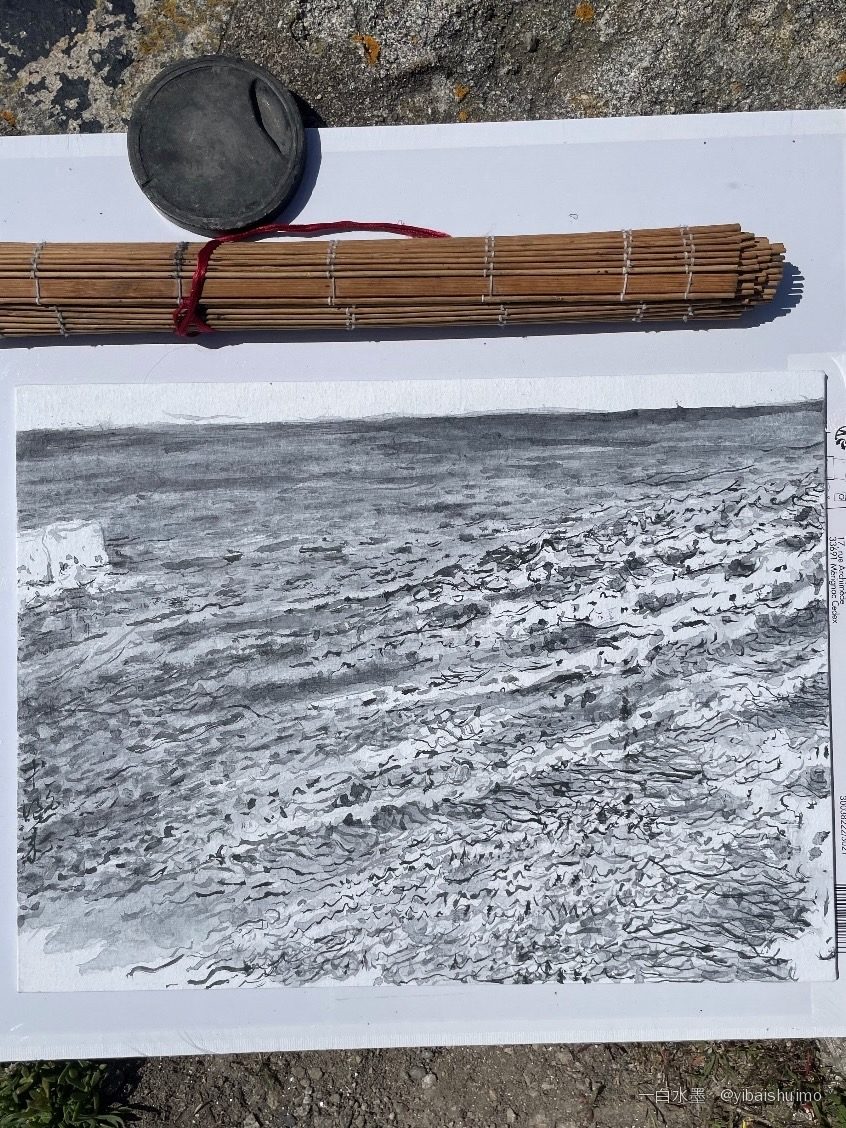
How do I paint water? To answer that would be dry, and dull for anyone listening; it is enough to look at the finished paintings. But if an answer is insisted upon, I would say simply: «I paint following the mood of the current.»
While I work, if it is very cold and I am shaking from head to foot and cursing this wretched weather from the bottom of my heart, I nonetheless go slowly and quietly into the painting and forget the cold. If the sun is scorching and merciless, I smoke a couple of cigarettes, drink a couple of mouthfuls of tea, sit down, watch the current, let my mind settle, go into the painting, and no longer notice the heat, humming a song I learned the evening before and painting with real gladness. If the clouds come over, the wind gets up and rain is near, impatience takes hold of me and I finish the work at great speed, the brush all but flying. Works made that way are often the best, because they have rhythm, because the feeling in them is full, because they express what is truly felt. When the current runs fast the brush naturally goes faster; when it slows, the brush slows too. As to handling: I use the reversed tip for the most part, drawing from right to left and from bottom to top. This gives the stroke force, and it gives the line a furred edge that comes close to the shapes of the current.
After the fifteenth of April I went to Batz-sur-Mer, a small seaside town I have often visited. There I had the chance to paint sea water, whose rise and fall is far greater than the river's, and the feeling is not at all the same as with the Loire. The waves beat on the sand and the rocks of the shore with a roar close to a bellow, a cry. Painting waves, you must race the seconds, quick of eye and quick of hand, without even the time for a cigarette; you paint unconsciously, entirely on feeling, with no time to think, no room for any rational, physical analysis of one wave-set after another. The foam and the water spread gently up the sand and leave long winding arcs behind them, natural and deeply affecting. It is a greater challenge still, and I gained a great deal from it.
I noticed that the surface of the Atlantic stays calm from morning until about two in the afternoon. After that a strong wind arrives unannounced, and the sea grows restless: it leaps, it surges, it runs, it hurls itself against the rocks of the shore and breaks into flower after flower of white. Yet the horizon at the farthest distance lies quietly flat, and the water a little way out still seems calm, while close in a struggle of life and death is going on, exhilarating and frightening at once.
To paint the Loire, I first take in the whole surface of the water and the scenery of the far bank, getting hold of the breath of the whole; and what comes out is, on the whole, not bad. But painting the roaring sea is another scene entirely, a wholly different experience. It asks only for feeling and intuition; it has no need of reason or logical analysis. This accords exactly with the idea of making that I have always held, and it satisfies me completely.
This time spent painting water has set me thinking a great deal about what I should make when I get back to Nanjing, back to the studio. Painting in the Loire valley, the water moves and the scenery along the bank stays still; at Batz, everything moves. For my part I genuinely love the challenge of painting moving water: there is passion in it, and a keen pleasure. It suits my rather impatient nature, and it suits the grounding of all those years practising cursive script.
What shall I make when I am back in the studio? What subjects? I have no answer yet, but two directions are faintly there in my mind. The first: the picture must keep the passion of the strokes and the traces of ink. The second: to trust intuition more in the making, and to use with greater command the pictorial language I already have: straight lines parallel, crossed and repeated, and the «black» arrived at by writing calligraphy until the paper turns black.
More than a month has gone by since I left my own country, and everything here, the people and the circumstances, is entirely changed. Apart from painting, I naturally miss my family, my friends, the food I know. The rest of the time is spent mostly in blankness and idle thought. To be cut off in space from one's familiar surroundings is, for an artist, a rare and thoroughly beneficial piece of luck: it lets you see your own strengths and failings clearly, easily and naturally, and lets you go on with a steady step.
One last thing must be stressed: intuition, the intuition of a single instant, is the artist's most precious weapon of all. It can overcome the interference of science, of technology, of established civilisation, and it is the one resource by which art continues to exist.