Essays · Nets
The Birth of a Fishing-Net Painting
一幅渔网作品的诞生
The fishing-net works were born of two sources. The first lies in old painting: in landscape painting above all, where net-like tackle resembling a fishing net or a lift net appears now and then, usually as a small incidental feature in the water country of the Jiangnan. The second is the real, physical presence of fishing nets in the little rivers of my native place, the water country around Yangzhou. Together with the memories of childhood, these things pressed feeling towards utterance, and out of that came the urge to make work about the net.
In the early days my manner of painting was close to realism. Slowly I came to see that I should not paint that way. First, realistic reproduction has no meaning, since photography can do it instead. Second, a mature work must keep a certain distance from the things of nature, in form and in physical property alike; otherwise there is no need to paint at all.
Two straight lines crossing in parallel ranks: I can no longer recall how this language came about, but I remember clearly that I was after an effect of layer upon layer. Somewhere in my unconscious the language must owe something to Western copperplate engraving, though I stubbornly deny it to myself. No matter. As for that layered effect, it must have come from the reflections of things on still water, which drew me powerfully; reflections at once transparent and solid were the original impulse behind the net paintings, and the repeated, crossing ranks of parallel straight lines appeared with them, by chance.
The small boat entered the picture soon after, for three reasons. First, the boat is an important motif in traditional landscape painting, and appears there very often. Second, in my native place the boat was a common means of transport, before roads and railways became general. Third, although the boat is only an incidental feature in classical landscape, its meaning runs deep: it is an object charged with divinity, with strong symbolic force, gathering into itself the sensibility of the literati, religious colouring, the practical business of transport, the disgrace of the exiled official, the fisherman's retreat among rivers, and untrammelled ease.
The boats in my own net paintings owed their shape at first, and directly, to those in the work of Wu Zhen of the Yuan dynasty. Little by little they changed: they took on perspective and grew more decorative, and I draw them with as many straight lines as I can, in keeping with the straight lines of the net. In the same way, the bamboo poles, the crossing ranks of lines and the structural lines of the boat all appear in the picture as straight lines.
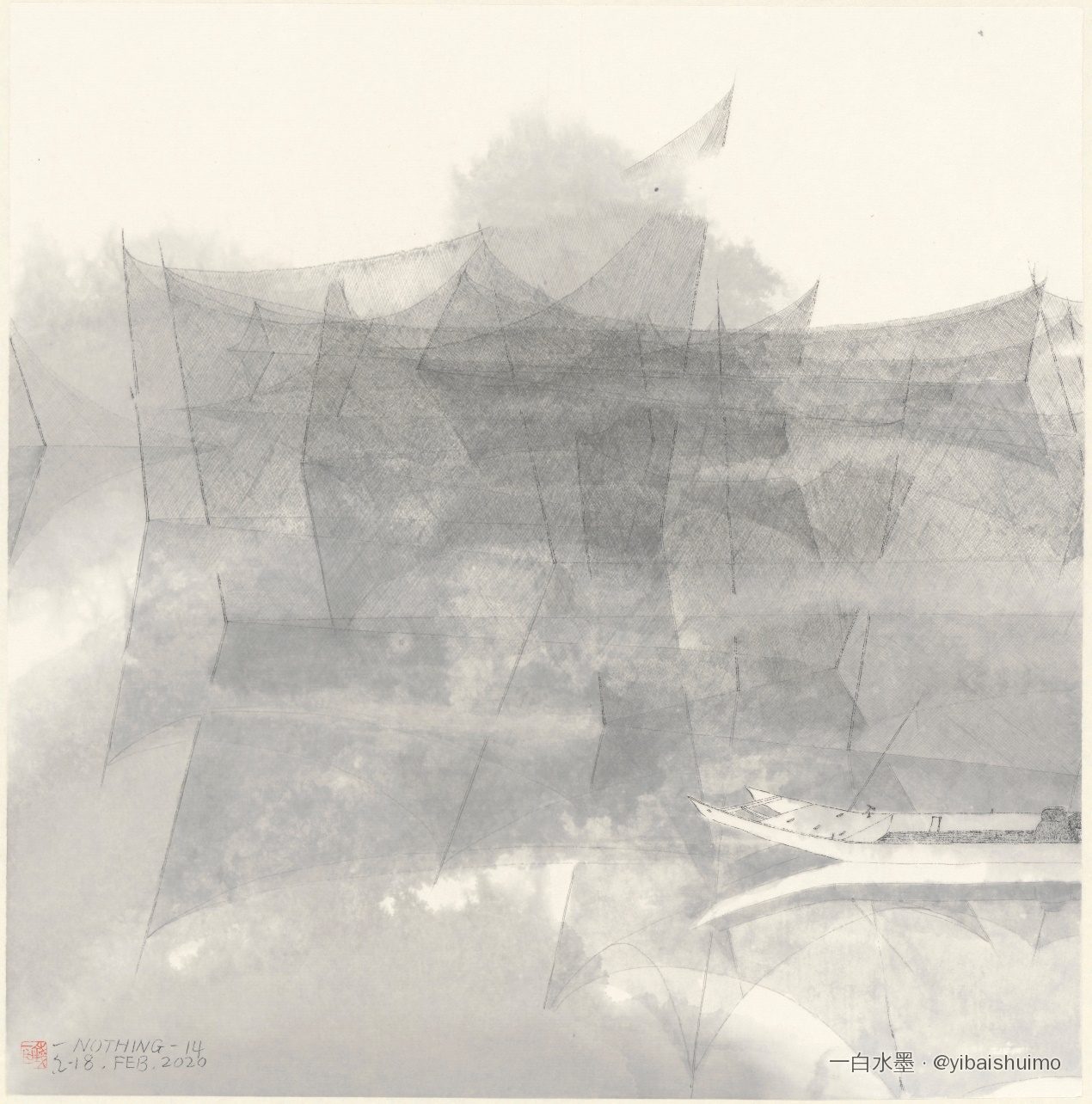
Then comes the treatment of the reflections. At the very top of the picture are the reflections of distant mountains, generally a blend of the peaks of traditional landscape painting with those of the real world. The reflections of the bamboo poles and of the boat are made as answering lines, while the broad reflected surfaces of the net are filled with a flat wash of pale ink.
Finally, I should like to speak of the idea underlying the net paintings. I have always held that the supreme law of painting is that the simpler a thing is, the more resonance it carries: straight lines, no colour, a pared-down subject, pale ink. When these simple, repeated materials meet on the white xuan paper, a plain and artless resonance arises. That is what I am working towards.