Essays · Manifesto
Reflections on Creation
创作有感
Before I speak of what my work has taught me, I want to say that art takes many forms of appearance, and that sincerity is the precondition of making anything at all.
«Seeing is believing» is not necessarily the truth. Only through thought, and through the mind's own contemplation, do we come near what is true.
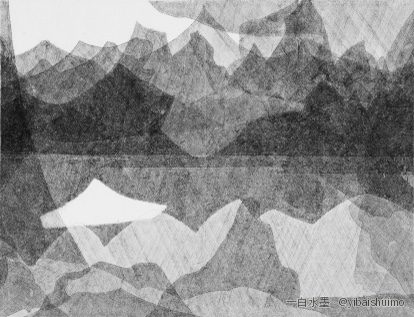
Before I begin a painting, I already have a language of my own: straight lines interwoven and laid parallel; a patch of «black» (made by copying the Small Cursive Thousand Character Classic of Huai Su of the Tang in pale ink, covering the sheet again and again until it turns black, an activity that is useless, which is to say free of all self-interest); and a patch of «white» (the void deliberately left). Together they give the picture its register of black, white and grey. The theoretical ground of all this is Chan. Chan seems to me a great synthesis, gathering the philosophy of the Confucian, Buddhist and Daoist classics. What I read in Chan is the refusal of any single mould, the breaking of every rule. Carried onto the paper, this means: do not paint a painting the way paintings are painted, do not aim at a pictorial effect.
Does this sound obscure? It is not. It exists, quite concretely, and the maker can feel the presence of Chan only through a quiet mind emptied of stray thought. As Rilke said: «Only by opening the eyes of the soul can one truly see those three things that are in fact one: God, landscape, and art.»
My materials are the traditional Chinese ones (brush, pine-soot ink, xuan paper) and what appears is ink on paper. But my technique has already taken its distance from traditional ink painting; ink on paper is for me no more than the material vehicle of my thought.
Why paint? Because I have an irresistible desire to express.
What to paint? Anything that moves my heart.
How to paint? In a way that resembles no one else.