Essays · The State of Freedom
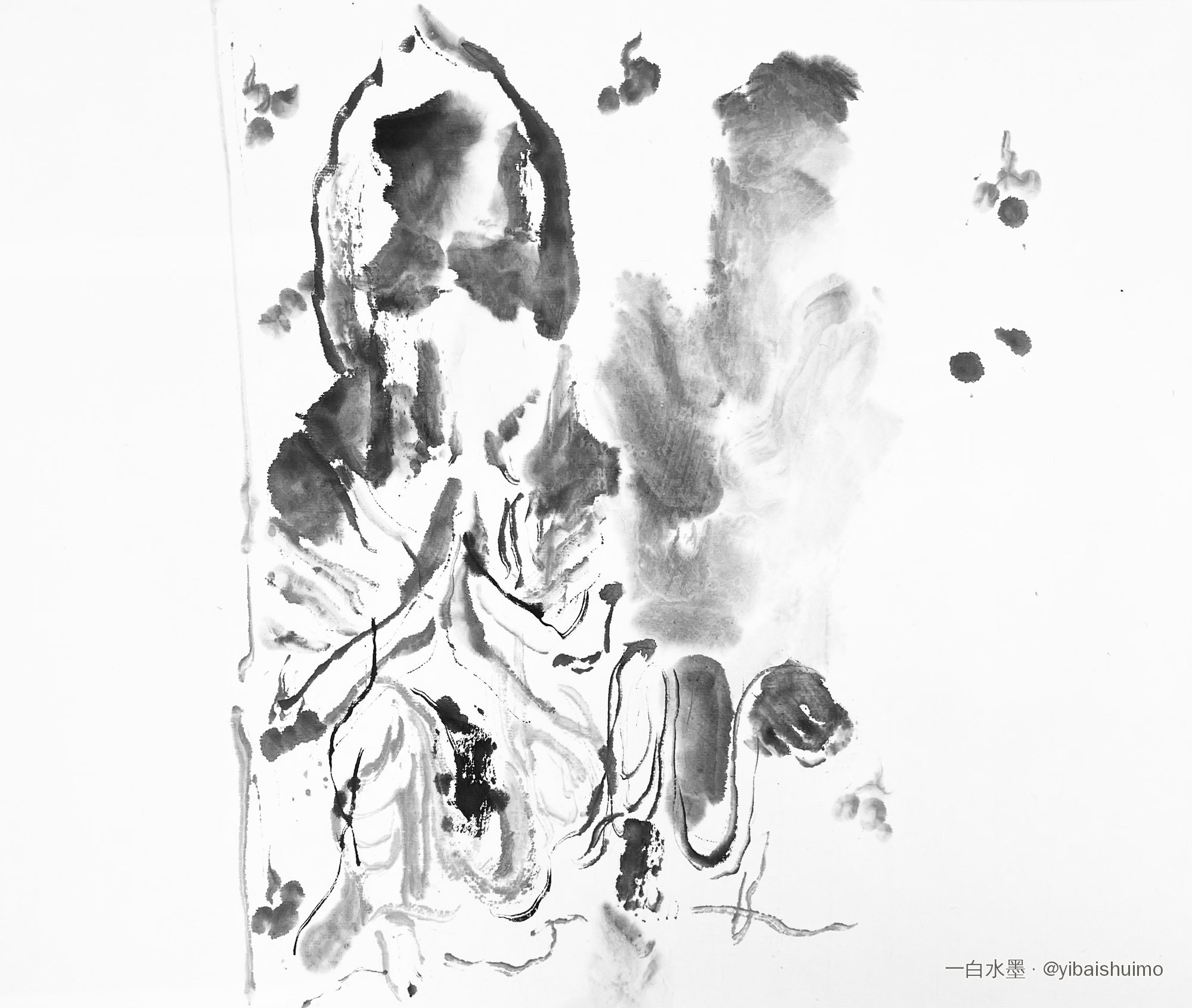
Postscript to the Free Painting The Donor Bodhisattva of Dunhuang Cave 248
戏画《敦煌248窟供养菩萨》后记
When did I paint this? I truly cannot remember. Two things, though, I know perfectly well. First, that I painted it with great ease, purely by feeling, with no logic to it whatever; I was most likely smoking a cigarette, drinking a beer, perhaps even talking with friends at the same time. Second, that once it was done I thought nothing more of it.
And that is where it becomes interesting! Later, quite by chance, I had the paper mounted. When I saw it, I was astonished myself… This, this is wonderful! Did I really paint it? Today I found the original image the work had come from, The Donor Bodhisattva of Cave 248 at Dunhuang. Set the two side by side and the painting stands between likeness and unlikeness. The form is certainly not accurate; the feeling is exactly right.
Because I painted so freely, with no purpose, caring nothing at all about the question of form, the whole nevertheless answers its subject perfectly, and carries a markedly airy, drifting grace.
A phrase came to me then: when the mind stirs, the spirit tires. My mind at that moment held no stray thought; it certainly did not stir. There was no aim, no guidance and no temptation, still less any calculation of gain. There was only feeling: full, and charged with original vitality.
The late-Ming Chan master Dandang once wrote, in a colophon after a painting:
« If a single stroke is made as painting, it is not painting; if no stroke at all is made as painting, that is not painting either. »
This work comes close to such a state. While painting it I cannot have taken it for a painting at all. Brush and ink were in a condition of indifference, of no rules; there was no expectation and no burden, a state of absolute freedom answering to neither law nor heaven, in which the distinction and the opposition between myself and the work had fallen away. I was the work, and the work was I. Phrases like « heart and hand both flowing freely » or « the hand obeying the heart » cannot describe it with any precision.
It answers exactly to Qi Baishi's saying: « the marvel of painting lies between likeness and unlikeness ».
As I painted, there was no longer any I, nor any painting, nor any paper; or if an I remained, that « I » had turned into the figure within the picture. Were I still merely I, and the painting still merely the painting, the two never fused into a single body, such a work would be a failure: a waste of ink and paper, and a squandering of time.
How does one bring self and painting into one body? It rests on inspiration, aided too by samadhi, which belongs to Chan. Then the picture breathes, of itself, with the movement of life and spirit. To enter a state of complete freedom is an artist's good fortune!