Essays · Black
An Experiment in Applying Zones of ‘Black’ to Painting from Life
把“黑”色块运用到写生中去的实验
To go out into nature and draw from life is a way of putting an artistic idea into practice. It calls for a sharp and accurate eye, and for the courage to discard whatever is irrelevant, including one's own habits.
The first thing is to fix all my attention on the patches of black in the subject, large and small and of every shape. Rock, earth and timber, vegetation, light and shadow: whatever it is, if it is black enough it becomes my quarry; and everything else, however splendid, however strongly it draws my eye, I simply do not see. It has not reached the degree of « black » that I am after. Then, in the painting itself, I drop every habit I have ever had and set down only those patches of black, accurately, with the brush: no discriminating mind, no particular scene. What tree? What rock? What house? What footpath? What ox or sheep? On the paper it does not matter what you are; what matters is whether you are black enough, and only what is black enough earns the right to appear there. At first this felt deeply unnatural. I kept wanting to draw the whole of the tree, the whole of the rock, in all its detail… but the thought was put down at once: « only the black, only the black », I would remind myself under my breath.
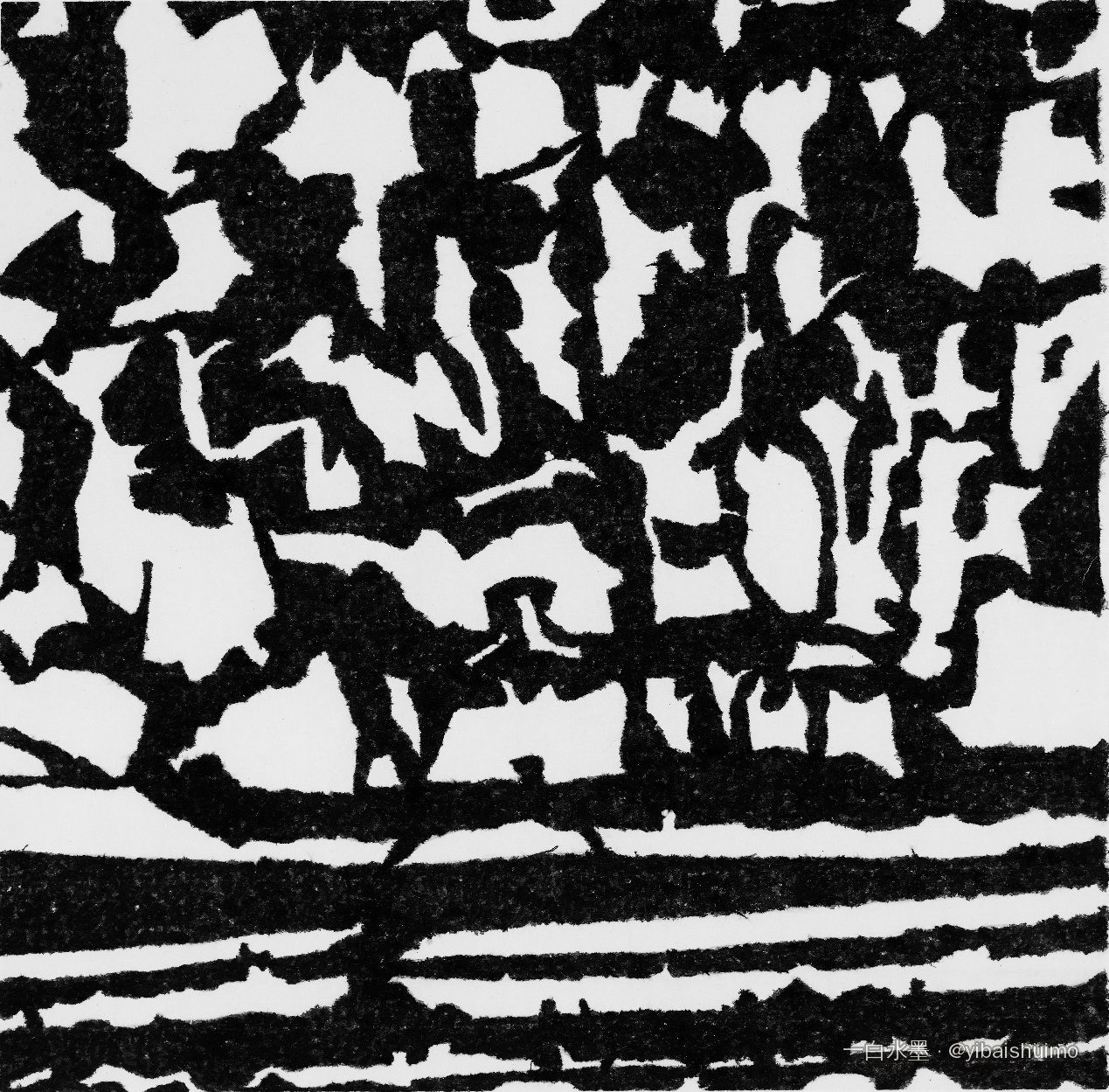
After three hours of struggling with myself I finally finished the work. I light a cigarette, draw hard on it, let the smoke out slowly, and keep my eyes on the picture: nothing but scattered patches of « black ». I feel loosened, and proud.
Discovering the patch of « black » was an important step on my road as a painter, the first step towards abstraction. The idea comes out of Buddhism: « all beings are equal » and « do not cling to appearances ». Whatever the subject before me, however beautifully it would sit in a picture, if it is not black enough it can forget about entering my painting; and however ugly it is, however unpaintable, if only you are black enough you are the guest of honour in my picture. That is what I take « all beings are equal » to mean. As for « do not cling to appearances »: whether the subject is a tree, a rock, a house, a person, an ox, a sheep, far mountains or near water, white cloud or blue sky: none of it matters to me. What I paint is not some particular thing; what I paint is what I need. Faced with any landscape at all, I paint only the patches of « black », and the rest vanishes as if by magic.
For instance, when I look at a person: the hair is black, the pupils are black, the shadow in the nostrils is black, the belt is black, the trousers are black; the shirt is a greyish white, the shoes pale yellow, the arms and hands yellow. So I paint only the « black » parts, and everything else magically disappears. Isn't that a fascinating thing?