Essays · Black
The Making of a ‘Black’ Landscape
一幅“黑”风景作品的创作始末
A small county town in central Hunan is my wife's native place. The hills there are green and the waters clear; everything is natural and at peace. Her family's house stands on a little rise called Paishang, ringed about by hills that fall into one another at irregular heights. Paddy fields lie scattered before the house and behind it; the trees are thick and green the year round, slender bamboo draws in the wind, banana leaves rustle and slap, weeds grow rampant, cocks crow and dogs bark. A small stream winds past below and to the right of the house, murmuring without cease; at dead of night especially, the sound of the water enters the ear note by note. The air is fresh, the local ways plain and straightforward. It is a land I love deeply: a place to live in, to eat and drink in, to paint in, to sit in meditation…
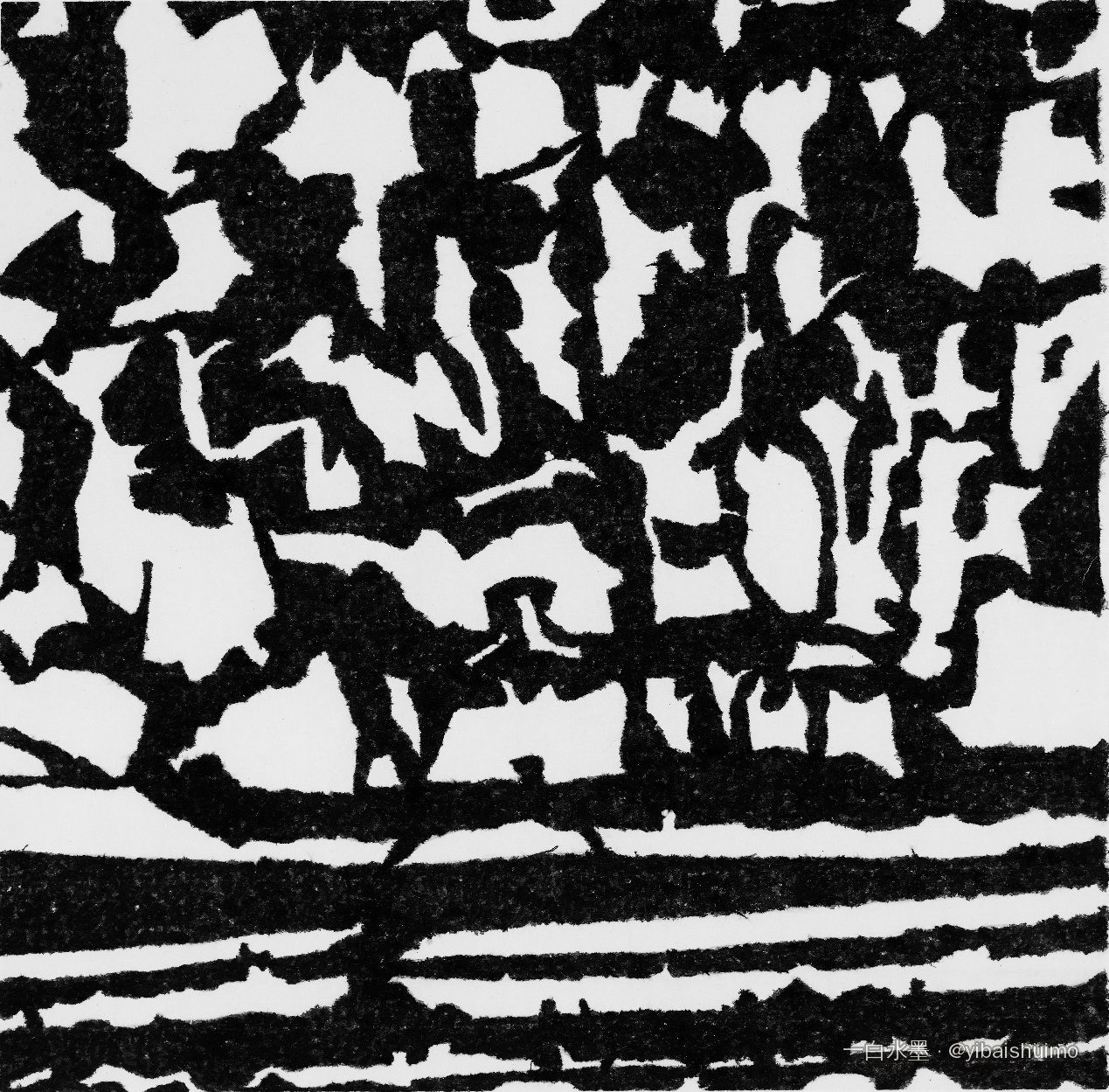
Once I had felt my way to the method of the « black » patch, I set out to make work with it. The hills and waters of my wife's native place were my first choice of material. I took a sketchbook, a pencil, an eraser, and walked out into nature. Choosing one portion of the hill opposite, I began slowly to draw out the « black » patches within it: a singularly demanding session of drawing from life. First, I had to strip away the habitual, fixed notions of hill, tree and shadow. Second, I had to fight, again and again and without mercy, against my own old ways of working from life. Third, a picture as small as this one, in earlier days, would have been finished with pleasure in half an hour at most; but now I had to hold my patience: draw slowly, correct slowly, weigh each thing slowly, and be exact. It took a full three hours to complete.
Back in Nanjing I had the drawing scanned, enlarged to the same proportions and printed out. Over this I laid a sheet of chanyi (a rice paper as thin as a cicada's wing) and traced the outlines through in pencil. Then, with brush and pale ink, I laid a flat wash over each of the planes; and finally, in pale ink again, I copied out the Thousand Character Classic in small cursive by Huai Su, the Tang calligrapher, over and over, front and back, layer upon layer, until I had reached what I judged to be « black » enough. With that, the « black » landscape was done.
The word « abstract » carries any number of definitions in the reference books. My own understanding of it is very simple: I go straight to the word itself, which is to draw out from the subject whatever I consider essential. Though the work comes from a real scene, nothing figurative remains in the picture that results. In my own practice, I take from the landscape only the patches of « black », paying no attention to the particular forms of hill, rock, tree, grass or shadow. In this way the picture holds nothing but patches of « black », and there its relation to « abstraction » begins. Moreover the whole picture holds only « black » and « white », in a strong contrast.
As for the process of writing that produces those patches of black, the viewer cannot see it; what can be seen is only the black. This accords exactly with my idea of what making art is: without meaning, without use, without profit.
And what possibilities lie ahead for work of this kind? My answer: let things take their own course.