Essays · Manifesto
A Few Hopes for My Ink Painting
对自己水墨创作的几点期许(畅想)
Ink painting grew up within an Eastern context. Its history is long, its spirit deep, its language rich, its pictorial sense exquisite. Set within world art as a whole, it stands at the highest level still, at once singular and universal.
What makes ink painting singular rests on three things. First, its particular materials: brush, ink, paper and inkstone all grew out of Chinese soil. Second, its distinctive techniques, which came forth from the deep ground of Chinese civilisation. Third, the fine savour of its brush and ink, which shares a common source with calligraphy and is nourished by it in return.
Its universality has shown itself over the last two hundred years, in the exchanges and collisions between Western and Eastern civilisation, in their mutual influence and understanding. Ink painting is one category of art; and being art, it carries universality within itself and needs no explanation. I am convinced that anyone, in any corner of the world, has the capacity to receive it and to take pleasure in it.
It is true that over these two hundred years the industrial and scientific revolutions of the West brought rapid economic, political and technological development, and with it a vigorous expansion of culture, so that Western culture and art became the world's mainstream. Ink painting was at once pushed to the margin, into the awkward position of something minor. But over the past thirty years of reform and opening, China's economy and culture have developed rapidly and gradually entered the world, and the situation of ink painting has improved; its standing has risen somewhat.
I began to approach ink painting, to understand it and to study it, around the year 2000. Twenty-five years have passed, and I have drawn a few conclusions. Ink painting and its materials are wholly singular. Its techniques require the participation of calligraphy. The inner state it can reach must be built on Confucian, Buddhist and Daoist thought. Ink painting must cross the oceans and go out, so that other peoples and other audiences may see an art so singular and so profound. Ink painting must take its place within the family of world art.
My own experience and practice give me great confidence in the height of ink painting. Painting from life in Europe, for instance, before an old Gothic cathedral, the lines in my picture are inevitably calligraphic lines: the benefit of my long training in calligraphy. There is also the light and perspective of Western painting, the brush and ink of the East, the technique of Western watercolour. The spiritual core is Eastern, the method of observation Western. If such a work may be called an ink painting, it is, I am firmly convinced, because of the presence of calligraphic line in it and the faint showing-through of Chan. This is only one example; the same holds for the many landscapes and things of the Chinese earth.
Take free ink painting: my Reworking of the Donor Bodhisattva of Cave 248 at Dunhuang. I recall the making of it only dimly. One afternoon in the studio (I do not remember the weather) one or two friends came by. They leafed idly through an album and came upon an image of the Donor Bodhisattva of Cave 248. A vital energy surged up in me. I saw my friends politely to the door, shut it, spread out a sheet of xuan paper and began at once to paint: with no purpose, no burden, no stray thought, in perfect ease, with no method, no order of steps, no ancients, no moderns: entirely free. Ten minutes at most, and it was done. I tossed the painting aside and thought no more of it. Two or three years later I came upon it by chance and was astonished. So alive! Did I paint this? So subtle! How did I paint it?
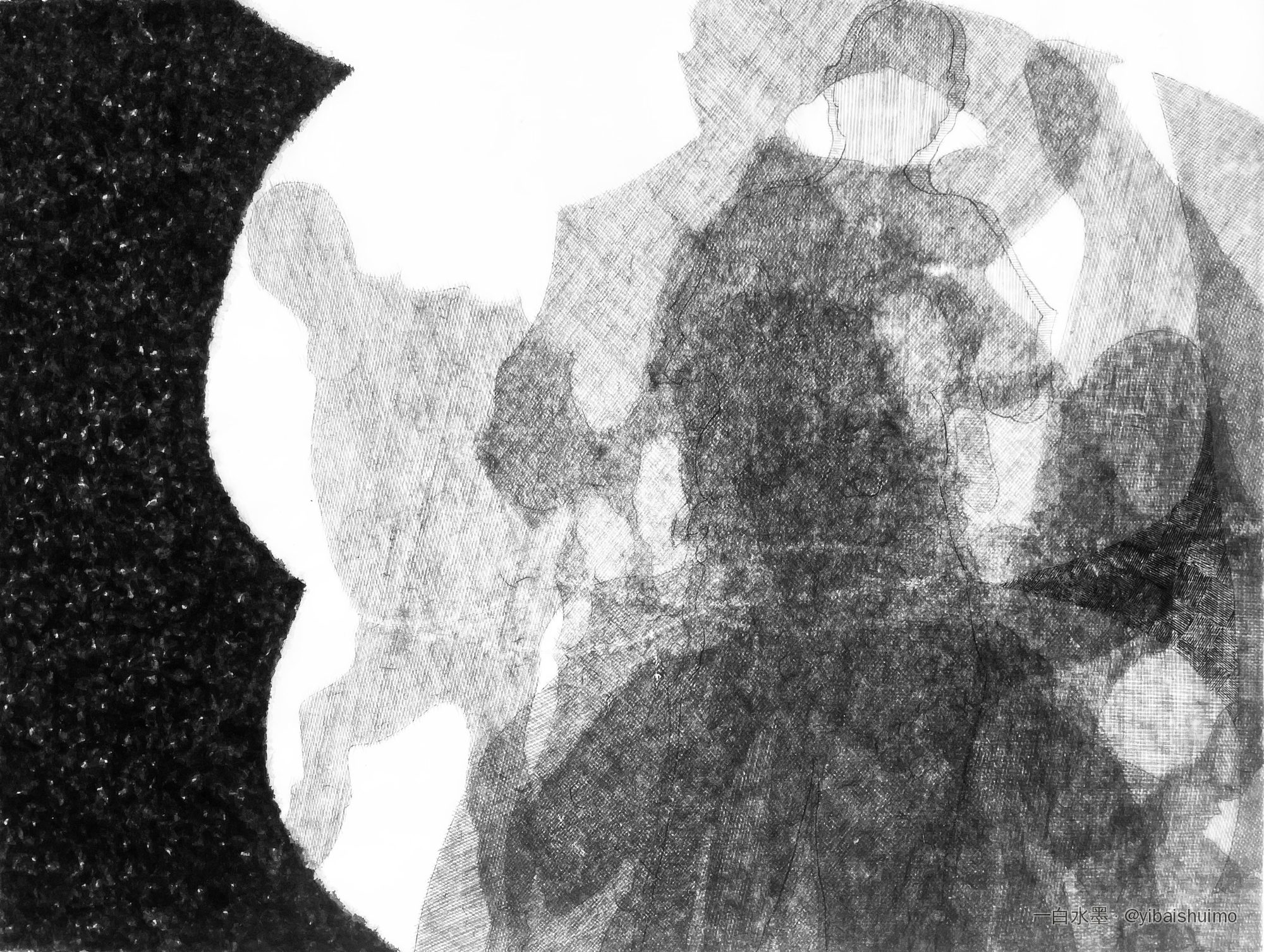
I would account for this painting in two ways.
First, it answers to the three levels Zheng Banqiao, the Qing dynasty painter, set out in his notes on painting: «the bamboo seen by the eye», «the bamboo in the breast» and «the bamboo in the hand».
«The bamboo seen by the eye» is the image of the Donor Bodhisattva of Dunhuang; the moment I saw it I was moved, and the desire to paint rose in me at once.
«The bamboo in the breast» is a long train of dots, lines and planes composing themselves in my mind, marvellous ideas on the point of bursting forth, held back by no rational constraint.
As for «the bamboo in the hand»: brush in hand, I ranged across the paper at random, back and forth in a single breath, heart and hand both flowing freely. By then the bamboo seen by the eye and the bamboo in the breast had left no trace; and yet a painting had appeared. I was at a loss, a little tired, and I went off to do something else.
Second: while painting I may have been smoking, or drinking; I do not remember. At that moment there was no «I». The «I» had been pulled into the xuan paper; «I» was the painting and the painting was «I». The natural opposition between the physical and the painted was gone, no subject and no object remained, and the two were wholly one. Only later did I know that it was inspiration, or samadhi, that had pulled the «I» into the painting. What a marvellous moment. Whatever I did then, however I painted, was right and exact. Later I understood that the forms in the painting are not accurate as form, but are entirely accurate as feeling. This is the state that ink painting can reach, what is called «spirit resonance, life-movement». In Western terms one might say: inspiration had unified form and content completely.
Let me add this: an artist must first be an extremely diligent craftsman, and then must possess great wisdom rather than small cleverness. He must often still his mind and nourish his breath, so that inspiration will visit him often.
Now let me speak of my ink language, which is to say my personal style. The circumstances of making my first Fishing Net, fifteen years ago, I have forgotten; but looking at that yellowed sheet, feeling rises in me. Bamboo poles stand leaning at all angles above the water, a single skiff lies flat on the surface, and at the top of the picture one or two reflected ridges of distant hills. The skiff, the poles, and the planes that link one pole to another are all made of surfaces woven from countless straight lines ranged, crossed and ranged again, and every one of them has its reflection. Beyond that, apart from the blank of the paper, there is nothing.
From there came several boats ranged in a row; then the boats were dropped; then came nets with sky and cloud reflected across the whole sheet; and now nets with no mass of ink anywhere, made entirely of straight lines. The pictorial language was settled: countless straight lines, crossed, parallel, ranged side by side.
Here I should set out the theoretical ground. First I was marked by the Daoist teaching of Wu, non-being; then by the Buddhist teaching of emptiness; then by the Chan teaching of sudden awakening. This led me to strip away, and go on stripping away without wavering: away with erudition, away with authority, away with technique, away with experience, away with logic, away with concept. At the end there remained a straight line: a crossing line, a line ranged parallel. It may be little enough that remains, but it is precisely mine, my pictorial language. I have always held that one studies not in order to pile up learning, but in order to find the courage to discard the ideas and methods of ancients and moderns alike, and so at last to find oneself. That is my first language: the straight line.
During the COVID period, with so much made difficult, obtaining brushes, ink and paper was a hard business. I have the habit of copying Huai Su's Small Cursive Thousand Character Classic straight through every week. With no maobian paper to be had, I had to write on xuan paper, writing over and over, on both sides, layer upon layer, and what finally appeared was a singular patch of «black» with a real substance to it, raised and uneven under the hand; black without being cloying. It was one of those happy accidents: one plants without intending to, and the willow takes root.
Then I sat before that patch of «black» and fell to thinking: how should it enter my paintings? And this «black» accords exactly with the idea of uselessness in art. I copied carefully, sheet after sheet, layer over layer, and only I know what was written and how; what appears at the end is a patch of «black». I used pale ink, writing again and again, front and back, the right way up and upside down, covering what was there, and it took care of my calligraphy practice at the same time.
Travel was restricted then, a swab test was required every day, and painting outdoors from life was a luxury. So the idea came to me of painting my wife's body. With her consent I began to work from the female nude, searching out line and plane and the relations between them, and little by little this patch of «black» entered the work. In the nudes there are patches of «black»; the «grey» areas continue with the countless straight lines crossed and laid parallel; and the «white» areas are the void deliberately left. Later only a few patches of «black» appear in a picture: very pure, and very demanding.
This May I began working with nothing but countless straight lines, crossed and laid parallel. The process is full of difficulty, but I am convinced that this road can yield many possibilities and is worth going on with.
At this moment I would say that a true artist must have a language of his own. In this I have been fortunate. It goes back to the vow I made on the first day I came near ink painting: to be a painter unlike any other. For art is freedom, and art exists precisely by virtue of its creative nature.
Finally I would say that art is the work of truth: the truth of beings happens in the work of art. When truth sets itself into the work, it shows itself; and this showing (this being of truth in the work, and as the work) is beauty. Truth is unconcealment, the absence of covering, clearing. Truth is the Buddha: all beings possess the Buddha-nature. Why then do so few awaken and become Buddhas? It is as when the clouds part and the sun appears. Beings lack the strength or the courage to let go of their attachments, their habits, their temptations, their defilements, their possessions: all those clouds. Yet truth is present at every moment and in every place, and usually in a simple and rough form.
It is the same with art: it appears in a very ordinary and simple way. Do not make it so complicated, do not give it so many adjectives; it is a noun. To make a painting, first empty yourself; set the brush down with ease and composure, without purpose, without interest, without self and without painting. I am the painting, the painting is I; one sees things by way of things themselves. A painting made so will certainly be fresh and free of the common. As for spirit resonance and life-movement, do not force it: that requires inspiration to lend its aid. If it comes, the work has spirit resonance; if it does not come, no matter. But inspiration is always in readiness for the artist who is himself always ready, and who stays ready.
As for truth appearing in the work: truth is the artist's clear and lucid attitude toward the world and toward what is essential in human beings. That attitude enters the work naturally and in silence, and there is no need to worry about it.
One more thing I must say. Chan brought me to a way of thinking that is intuitive and not rational: no deliberation beforehand, no raising of distinctions, no weighing of meanings, no fixing of names. One knows logic and causation, but one is not blinded by them; one does not let the concept run ahead of the seeing, and one does not judge in advance. One looks always as if for the first time, and trusts nothing but intuition.