Essays · Chan
Three Reflections on Chan
关于禅的三点体会
Chan Master Qingyuan Weixin of the Tang said: «Thirty years ago, before I took up Chan, I saw mountains as mountains and rivers as rivers. Later, having met a teacher and found a way in, I saw mountains that were not mountains and rivers that were not rivers. And now, having come to a place of rest, I see mountains once again simply as mountains, and rivers simply as rivers.»
Setting this beside my own experience in painting and in literature, I understand it roughly thus. First, one comes to the world with no experience, no concept, no knowledge: mountains are mountains, rivers are rivers, and what one sees is the surface and the shape of things. Then, through study and practice, one acquires a certain learning, certain views, certain experience. Seeing a mountain, one naturally thinks of what one has learned (poetry, say) and decides the mountain is not merely a mountain: she smiles, she is a beautiful woman, she is dressed in colours. Seeing water, one thinks of fallen blossoms drifting on a stream, of lovers' stories, of the Peach Blossom River; and it is no longer simply water. At last one arrives at a certain state and can pass through appearance straight to essence: mountains are simply mountains, rivers simply rivers. The distractions fall away and only the original face remains.
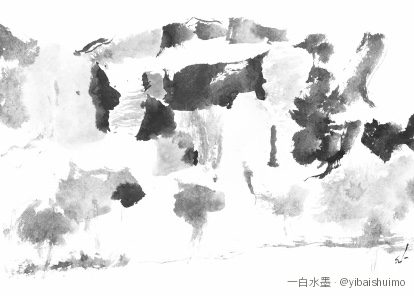
The path of my own painting has gone the same way. At the start I painted faithfully whatever I saw: a mountain, I painted the mountain; water, I painted the water. Nothing else was on my mind; I only tried to raise the level of my hand, to make the painting both like its subject and full of savour. Then I came upon the work of many masters and read a great many books, and understood how much my own style and pictorial language mattered; I had at all costs to be unlike anyone else. Quietly, the work turned abstract. Painting mountains and rivers, for instance, I looked only for the «black» masses within the landscape and painted only those; no concrete mountain, tree or water remained in the picture, only «black» masses of strange sizes and shapes. With no particular mountain and no particular water left, one arrives at seeing the mountain and it is not the mountain, seeing the river and it is not the river. And in the stage of awakening that follows: I see a mountain and paint the mountain, I see water and paint the water, I see a tree and paint the tree. I ask nothing of East or West, nothing of figurative or abstract, nothing of style, nothing of you or me, nothing of feeling. I simply paint mountains and water.
I think I stand at present in the stage where the mountain is not the mountain and the river is not the river. I have found a pictorial language of my own, the work has begun to turn abstract, the feeling in it is full, and the hand moves freely.
As for the state of true awakening, I am nowhere near it. Yet now and then, when inspiration flashes, I paint something rare and beyond the common, which is precisely the proof that my grasp of Chan is still slight. No matter. Slowly, quietly, naturally, I shall come to understand it, and the joy of it will rise in me.
A wandering monk asked an old monk: «Before you attained the Way, what did you do?»
The old monk: «Chop wood, carry water, cook the rice.»
The wanderer: «And after you attained the Way?»
The old monk: «Chop wood, carry water, cook the rice.»
The wanderer: «Then what is attaining the Way?»
The old monk: «Before, when I chopped wood I was thinking of carrying water, and when I carried water I was thinking of cooking the rice. After, chopping wood is chopping wood, carrying water is carrying water, cooking the rice is cooking the rice.»
This Chan case has helped me greatly in understanding Chan. At first I took it to mean that if one does a thing with an undivided mind one attains the Way: chopping wood, do not think of carrying water; carrying water, do not think of cooking. And on the undivided mind I do have some experience. In ordinary life I cannot do one thing and casually do another at the same time. If my wife is cooking and asks me to bring her a dish, I will; but if, while I am fetching the dish, she asks me to bring two spoons as well, I refuse on the spot. My way is to bring the dish first and then go for the spoons. Likewise with painting: however the thunderstorm rages outside the window, however great the commotion, the moment I sit down and take up the brush my heart is still water, and I enter the state of painting at once, undivided, with no stray thought in me.
Later I came to feel the case means more than this undivided mind. First, chopping wood, carrying water and cooking the rice are the daily round of Huineng's Southern Chan, «a day without work is a day without food», the monastery rule that anyone practising Chan must follow each day, entirely natural, as simple as eating when hungry and sleeping when tired. But chopping wood, carrying water and cooking the rice have a before and after and a chain of cause, and so they have a logic: first chop the wood, then carry the water, and only then light the fire and cook. There is an order in time. Chan, however, knows no before and after, and does not fall into cause and effect.
Brought to bear on my actual painting: when I paint, I first empty myself. No brush and ink of the ancients, no ideas of the moderns, no feeling exerting any pull on me; I simply set down the brush boldly, with no order of precedence and no causal logic. Because this is here, that must follow: such reasoning I discard without hesitation. Nor do I care what ought to be done according to any method, Chinese or foreign, ancient or modern. The habit and the rule in traditional ink painting that the lower left or lower right corner must be left blank: all of it has to be broken. The freer a work is of preconception and causal logic, the fresher, the freer and the finer it turns out to be.
I count myself fortunate to have this trait of the undivided mind. Because I have not seen much of the world and have no very strong logical cast of thought, I also have an easy way into Chan. Sensitivity, intuition, and a refusal of the beaten track are precisely an artist's most precious wealth.
In the first year of the Shangyuan era of the Tang (674), Huineng, then thirty-three, came to East Mountain at Huangmei to pay his respects to Chan Master Hongren. When they met and Hongren had asked why he had come, he said: «You are a man of Lingnan, a southern barbarian. How can you be fit to become a Buddha?» Huineng answered: «People may be northern or southern, but the Buddha-nature is neither. My barbarian body is unlike the Venerable's, but what difference is there in the Buddha-nature?»
This case is very famous; it says that all things possess the Buddha-nature and that all beings are equal. Then why do some become Buddhas while others remain lost? Because everyone has the Buddha-nature already. The Buddha-nature is like the sun, and for many people the sun is hidden behind clouds, so that they cannot find the Buddha-nature and are left bewildered and anxious. Part the clouds and the sun appears; see one's true nature and one becomes a Buddha at once. Awake, one is Buddha; asleep, one is a sentient being. That is the whole of it.
Set against my painting: at the start I learned from teachers, from books, from nature, from everything excellent, and when learning had accumulated deeply I began to dig inward. So I threw off everything I had learned from outside: the techniques, the knowledge out of books, the experience of my teachers, the authorities, everything with no bearing on myself. What remained, however pitifully little, was precisely my true nature: my own style, my own pictorial language. And what I threw off was exactly the cloud that hides the sun.
As for the equality of all beings and the possibility that all may become Buddhas: it means that anyone may become an artist. In fact only a very few ever do. The reason others do not is that they lack the courage to throw off everything learned from outside; so they never have a self, never a style of their own, never a language of their own.
The Buddha is made by one's own nature; do not seek him outside the heart.
- «Mountains are mountains, rivers are rivers»: this is a set of concepts, the received experience of the ancients taking shape before my eyes. These are words; the concept comes first. I see a mountain: ah, a mountain! The conceptual mountain, the physical mountain. And the same for water.
- «The mountain is not the mountain, the river is not the river»: when I go out to paint from life and see a landscape, I find myself thinking: how did Dong Yuan paint this? How did Guo Xi? How did Huang Gongwang? How did Dong Qichang? How did Paul Cézanne? And so what comes out is not pure; the picture is in a state of confusion. The trees are painted Huang Gongwang's way, the water Dong Yuan's, the distant hills Dong Qichang's, the rocks Cézanne's, and not one thing in it is my own.
- «Mountains are simply mountains, rivers are simply rivers»: by now I have abandoned the methods of the ancients and am swayed by no theory and no doctrine. I use only my own language to finish a work, and so reach the state of «the cloud in the blue sky, the water in the bottle».